
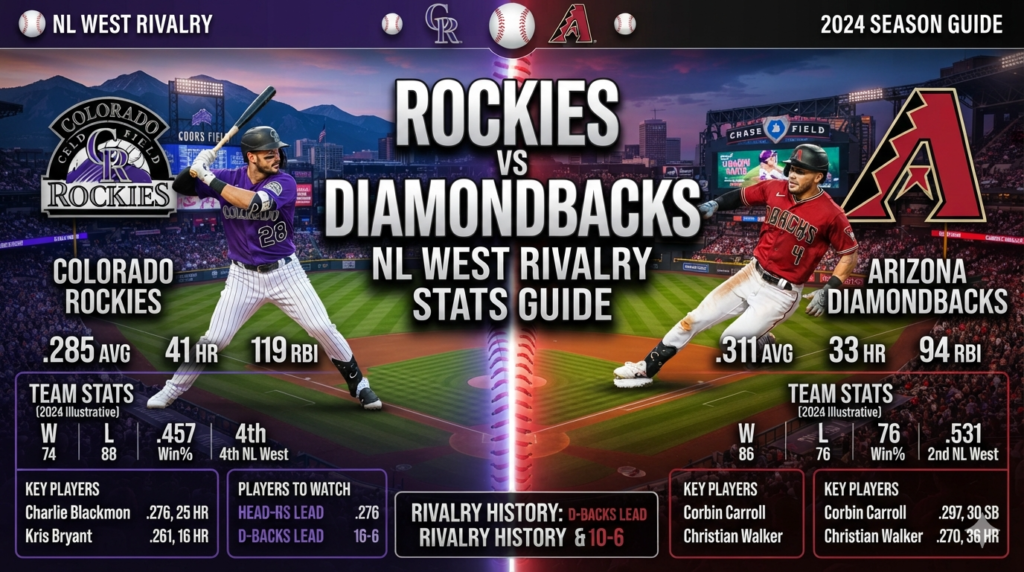

Major League Baseball is filled with exciting rivalries, but few bring as much high-altitude drama as the division games in the desert and the mountains. Every season, fans clear their schedules to watch the rockies vs diamondbacks match up on the diamond. Both teams play in the competitive National League West division, where every single win counts toward playoff dreams. Over the years, these two franchises have built a deep history filled with walk-off hits, high-scoring slugfests, and tense pitching duels. Whether they meet in Phoenix or Denver, baseball fans always expect a thrilling show.
When you look closely at the rockies vs diamondbacks head-to-head record, you begin to see how close and unpredictable this rivalry really is. Both organizations entered Major League Baseball in the 1990s as expansion teams, making their growth and journey very similar. They share spring training facilities in Arizona, which builds an extra layer of familiarity between the players and coaches. In this complete guide, we will break down team stats, key players, ballpark factors, and historical moments so you know everything about this exciting matchup.
Team Comparison & Quick Overview
To really understand how these two National League West rivals stack up against each other, it helps to look at their core facts side by side. Here is a helpful overview table comparing the two franchises:
| Feature | Colorado Rockies | Arizona Diamondbacks |
| Established Year | 1993 | 1998 |
| Home Ballpark | Coors Field (Denver, CO) | Chase Field (Phoenix, AZ) |
| Division | NL West | NL West |
| World Series Titles | 0 (NL Pennant in 2007) | 1 (2001) |
| Team Colors | Purple, Black, Silver, White | Sedona Red, Sonoran Sand, White, Black |
| Mascot | Dinger the Dinosaur | D. Baxter the Bobcat |
| Spring Training Facility | Salt River Fields (Scottsdale, AZ) | Salt River Fields (Scottsdale, AZ) |
| Primary Ballpark Factor | High Altitude & Large Outfield | Retractable Roof & Air Conditioning |
Understanding the History of the Rivalry
The story of the rockies vs diamondbacks matchup began back in 1998 when Arizona officially joined Major League Baseball as an expansion franchise. Colorado was already established six years earlier, giving them a slight head start in building a fanbase. However, Arizona moved quickly, winning a World Series title in just their fourth season of existence. That fast success created an instant target on their backs within the NL West. Colorado responded years later with their famous “Rocktober” run in 2007, sweeping through the playoffs and sweeping Arizona in the National League Championship Series.
That 2007 NLCS showdown remains one of the defining chapters in the rockies vs diamondbacks historical saga. Colorado was on an unbelievable winning streak and won four straight games against Arizona to earn their first World Series appearance. Since that memorable postseason battle, both teams have fought back and forth for division control. Every game carries emotional weight for fans who remember those October battles. Even during rebuilding years, both clubs play with extra energy whenever they share the same field.
Coors Field Impact: Altitude and Offense
Playing baseball at Coors Field in Denver is a unique challenge that heavily influences the rockies vs diamondbacks outcome. Sitting at one mile above sea level, the thin air allows batted balls to travel much farther than in standard sea-level stadiums. Pitchers also struggle because the dry, thin air reduces the break on curveballs and sliders. As a result, games played in Denver often turn into high-scoring contests where no lead is ever safe. Outfielders have to cover massive ground because the outfield fence is pushed back to offset the altitude.
Whenever the rockies vs diamondbacks series moves to Denver, visiting managers must adjust their bullpen strategies carefully. Relief pitchers get tired faster in the high altitude, and breaking balls do not drop as sharply as they normally do. Arizona hitters often adjust by swinging for line drives into the gaps, taking advantage of the wide outfield grass. Meanwhile, Colorado batters rely on their comfort with the altitude to launch extra-base hits. This special environment makes every single inning unpredictable and fun to watch.
Chase Field Dynamics: Climate Control in Phoenix
On the other side of the matchup, games hosted at Chase Field in Phoenix bring a completely different climate and playing style. Phoenix heat during the summer months can reach over 100 degrees, so the stadium uses a massive retractable roof and air conditioning to keep fans and players comfortable. When the roof is closed, air density inside the dome acts more like a traditional pitcher-friendly ballpark. The ball does not fly as far as it does at Coors Field, which shifts the advantage toward dominant starting pitchers and sharp defense.
During a rockies vs diamondbacks game at Chase Field, tactical small ball becomes much more important for both squads. Teams focus on drawing walks, stealing bases, and moving runners over with sacrifice flies rather than relying solely on home runs. Arizona ground crews and managers know how to play to their home turf, utilizing fast turf conditions and quick infielders. Colorado hitters have to adjust their swing angles quickly after leaving the thin air of Denver to stay competitive on the road.
Pitching Strategy: Taming Hot Bats
Pitching in the NL West requires patience, grit, and smart pitch selection. In a typical rockies vs diamondbacks game, starting pitchers must adapt their style depending on where the game is played. In Arizona, starters can comfortably rely on their put-away breaking pitches like sweepers and splitters. In Denver, pitch grips change, and pitch movement shrinks, forcing hurlers to rely more on precise fastball command and sinkers to induce ground balls instead of airouts.
Bullpen management is another key area where the rockies vs diamondbacks battle is often won or lost late in the game. Relievers who throw high-velocity fastballs usually fare better in high altitude because velocity does not suffer in thin air as much as spin rate. Managers must carefully monitor pitch counts and avoid overworking key arms during long four-game series. A single mistake pitch in the eighth or ninth inning can completely flip the scoreboard in these high-stakes divisional matchups.
Offense and Lineup Deep Dive
When analyzing offensive firepower, both lineups bring a mix of young speed and veteran power to the plate. In recent rockies vs diamondbacks matchups, base running has played a massive role in deciding close games. Arizona frequently relies on athletic outfielders who can steal bases and turn singles into double plays with aggressive running. Colorado counters with physical power hitters who can drive the ball deep into the gaps and clear the bases with one swing.
Key players on both sides often step up when facing divisional foes they see more than a dozen times a year. Batters become very familiar with opposing pitchers’ release points and pick up subtle cues over time. That high level of familiarity means pitcher-batter matchups are chess matches. A young hitter might struggle against a starter early in the season, only to adjust and hit a clutch home run in their next rockies vs diamondbacks encounter a few weeks later.
Defensive Execution and Infield Play
Solid defense is often the unsung hero when these two clubs fight for victory on the field. Because both ballparks feature vast outfield territory, fielders must possess great speed and strong throwing arms. In a rockies vs diamondbacks contest, a running catch in the gap or a precise relay throw to home plate can save multiple runs. Infielders also face difficult challenges, dealing with fast turf in Phoenix and hard-hop grass in Denver.
Double plays are critical for stopping big innings before they spiral out of control. With high-scoring environments constantly looming, middle infielders must turn smooth double plays to give their pitchers quick outs. Managers regularly place their fielders in specialized defensive shifts based on hit-chart data to reduce hit percentages. The team that commits fewer field errors and makes routine plays consistently almost always comes out on top in these division clashes.
Shared Spring Training Roots
An interesting aspect of this rivalry is that both teams share a home ground before the regular season even starts. Salt River Fields at Talking Stick in Scottsdale, Arizona, serves as the spring training home for both franchises. During February and March, players share the complex, practice fields, and weight rooms. This proximity creates unique personal connections and friendly rivalries among players long before the real games begin.
Because they see each other daily in spring training, coaches get a front-row seat to monitor the growth of opposing prospects. Young players making their big league debuts in a rockies vs diamondbacks game often face pitchers they faced in exhibition games just weeks earlier. This shared spring foundation adds a respectful yet competitive layer to their regular-season games, as both squads want to prove who truly owns the facility and the division.
Fan Base Culture and Stadium Atmosphere
The fan experience during these divisional games is vibrant, loud, and full of color. At Coors Field, fans gather on the famous rooftop deck to take in mountain views while cheering for the home team. The atmosphere in Denver is relaxed yet passionate, with fans supporting their club through every rebuild and playoff push. Purple jerseys fill the stands, creating a welcoming sea of color for baseball lovers of all ages.
In Phoenix, Chase Field provides a cool refuge from the summer heat where families can enjoy world-class facilities and fun dining options. Diamondbacks fans bring high energy, especially during late-inning rallies when the stadium lights flash red. When a rockies vs diamondbacks series takes place, traveling fans from both states pack the seats, creating an energetic tug-of-war in the crowd. That fan rivalry fuels the players on the field to give their very best effort every night.
Head-to-Head Trends and Betting Insights
For sports analysts and casual bettors, studying recent trends provides valuable insights into how these games unfold. The rockies vs diamondbacks head-to-head records show that home-field advantage plays a huge role in the final score. Over/Under run totals are typically set higher at Coors Field compared to Chase Field due to environmental factors. Tracking starting pitcher home-and-away splits is essential for predicting which team holds the edge on any given day.
Another trend to watch is how both teams perform in night games versus day games. High afternoon temperatures in Phoenix can affect indoor humidity, while night games in Denver often see falling temperatures that alter ball carry distance. Bettors who follow team injuries, bullpen availability, and recent travel schedules gain a clear advantage when analyzing a rockies vs diamondbacks matchup. Staying informed on these small details helps fans better enjoy and understand the action.
Conclusion
The rivalry between Denver and Phoenix remains one of the most exciting divisional stories in Major League Baseball. As young talent develops and veteran leadership guides both rosters, every rockies vs diamondbacks series offers fresh storylines, dramatic finishes, and great memories. From high-scoring battles in the Rocky Mountains to intense defensive duels in the Sonoran Desert, these two franchises never fail to entertain sports fans across the nation.
Whether you are cheering from the stands at Coors Field, watching on television from home, or analyzing the latest player stats, this rivalry has something special for everyone. Be sure to check the upcoming schedule, grab your jersey, and gear up for the next chapter in this NL West showdown. Do you think the home team will dominate the next series? Share your predictions with fellow fans and join the conversation today!
(FAQs)
What is the historical head-to-head record for the rockies vs diamondbacks?
Both teams have played over 400 regular-season games against each other since 1998. The overall head-to-head win tally remains very close, with Arizona holding a slight edge in total victories. However, Colorado has won key historical matchups, including their memorable sweep in the 2007 National League Championship Series.
Why do games played at Coors Field feature higher scores?
Coors Field is located in Denver, Colorado, which sits 5,280 feet above sea level. The thin mountain air creates less air resistance on hit balls, allowing them to travel farther through the air. Pitchers also get less spin and break on their curveballs, making it easier for hitters to make solid contact.
How do the ballparks differ between Colorado and Arizona?
Coors Field is an open-air stadium with a large outfield footprint designed to offset high-altitude ball carry. Chase Field in Phoenix features a climate-controlled environment with a retractable roof and air conditioning to protect players from desert heat. These structural differences create completely unique playing environments for every rockies vs diamondbacks series.
Where do the Rockies and Diamondbacks play during spring training?
Both teams share a state-of-the-art facility called Salt River Fields at Talking Stick, located in Scottsdale, Arizona. They train at the same complex throughout February and March, playing several exhibition games against each other before the regular MLB season officially begins.
Which team won the famous 2007 NLCS matchup?
The Colorado Rockies won the 2007 National League Championship Series by sweeping the Arizona Diamondbacks in four straight games. That historic victory earned Colorado their first National League pennant and advanced them to the World Series during their famous “Rocktober” playoff run.
Where can fans watch or stream live games between these rivals?
Fans can watch live broadcasts through regional sports networks, national TV channels like ESPN and FOX, or stream games online using MLB.TV. Local radio stations in Denver and Phoenix also broadcast full play-by-play coverage for every regular-season game.