

Fast bowling is one of the most exciting parts of cricket. Fans love watching a bowler run up fast and hurl a heavy leather ball at incredible speeds. Nothing brings more energy to the stadium than seeing the speed gun hit new records during a match. Over the years, the Indian Premier League has showcased some of the quickest bowlers in world cricket. These fast bowlers test the skill and courage of batsmen in every match. When a ball zooms past a batter at extreme pace, the crowd goes wild with excitement. Every season brings new young talents who try to break existing speed records on flat pitches. However, bowl speed records are very difficult to break because bowling at maximum velocity requires incredible physical strength and perfection. Let us look closely at who holds the ultimate title for the quickest delivery ever recorded in the world’s biggest T20 league.
What Is the Fastest Ball in IPL History?
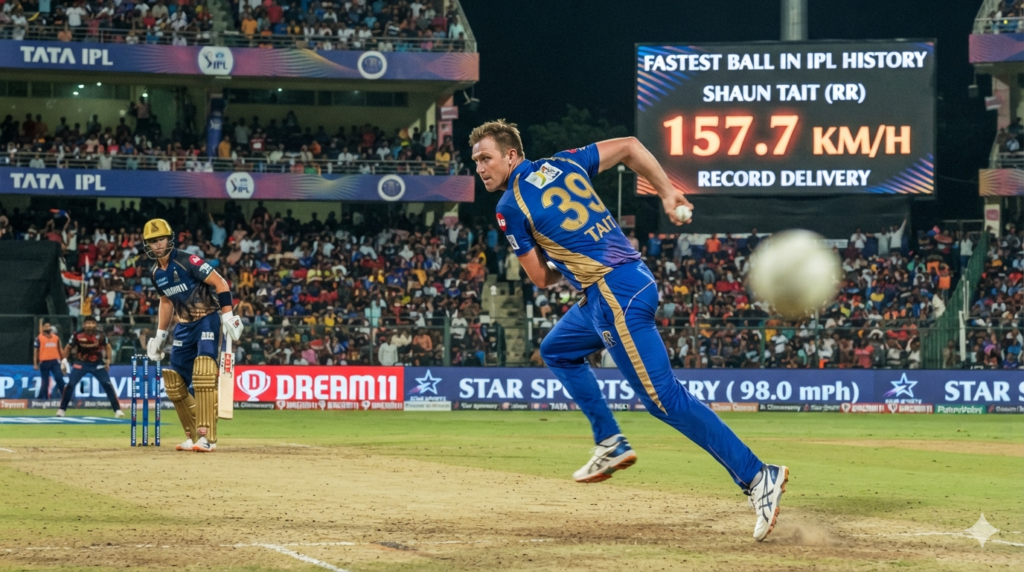
The ultimate speed record in the league belongs to Australian fast bowler Shaun Tait. He set this amazing record back in the 2011 season while playing for Rajasthan Royals. The official speed gun clocked his delivery at an unbelievable pace of 157.71 km/h (97.99 mph). When fans talk about extreme speed in T20 cricket, they always mention the fastest ball in ipl history shaun tait 157.71 thunderbolt. It happened during a high-stakes match against Delhi Daredevils at the Jaipur stadium. Tait ran up with intense energy and unleashed a pure rocket that flew past batsman Aaron Finch. The ball pitched just outside the off stump line and zipped straight to the wicketkeeper. Finch barely had time to move his bat out of the way before the ball was in the keeper’s gloves. Even after many years, no bowler has managed to beat this incredible speed record.
The Magical Moment: Fastest Ball in IPL History Shaun Tait 157.7 2011
To understand how special this moment was, we must look back at the fastest ball in ipl history shaun tait 157.7 2011 match in detail. Captain Shane Warne had asked Tait to bowl with maximum pace to pressure the opposition batsmen early on. Tait took his long run-up and gathered huge momentum before launching his bowling action. His unique sling action allowed him to generate extra pace that surprised every batter on the field. On his fifth delivery of the over, he unleashed the fastest ball in ipl history shaun tait 157.7 rocket that shocked the entire stadium. The speed display screen lit up instantly, showing numbers that made cricket history. Aaron Finch could only look back in complete disbelief at how quickly the ball zipped past his bat edge. It was a thrilling display of raw physical power and bowler technique. That single ball established Tait as a true legend of T20 bowling speed.
Shaun Tait Biography and Career Statistics
To appreciate the man behind the ultimate speed record, we must explore his background and career journey. Shaun Tait was nicknamed ‘The Wild Thing’ because of his explosive bowling action and terrifying speed. He represented Australia in international matches and was a star player for Rajasthan Royals in the Indian Premier League. Below is a detailed biography table summarizing his life, career stats, and iconic speed record.
| Profile Details | Information |
| Full Name | Shaun Edward Tait |
| Nickname | The Wild Thing |
| Date of Birth | March 9, 1983 |
| Birthplace | Adelaide, South Australia |
| Bowling Style | Right-arm fast (Sling action) |
| IPL Teams Played For | Rajasthan Royals, Kolkata Knight Riders |
| Fastest Delivery Record | 157.71 km/h (97.99 mph) |
| Record Opponent & Year | Delhi Daredevils (2011) |
| Total IPL Matches | 21 Matches |
| Total IPL Wickets | 23 Wickets |
| Best IPL Bowling | 3/22 |
Top 5 Fastest Balls in IPL History
Many fast bowlers have tried to beat Tait’s record over the seasons, but few have come close to the mark. The second spot belongs to Lockie Ferguson, who bowled a searing 157.3 km/h delivery for Gujarat Titans. Indian speed sensation Umran Malik holds the third spot with a rocket clocked at 150+ km/h for Sunrisers Hyderabad. South African pacer Anrich Nortje ranks fourth with a fast delivery of 156.22 km/h for Delhi Capitals. Legendary Dale Steyn and Kagiso Rabada also sit near the top with incredible deliveries above 154 km/h. Each of these bowlers brought immense excitement to fans with their terrifying pace on the field. Seeing young pacers charge in and bowl fast keeps the legacy of speed alive in modern cricket matches.
The Indian Speed Demon: Umran Malik’s Rise
For a long time, foreign bowlers dominated the top speed leaderboards in the Indian Premier League. That changed when a young pacer named Umran Malik emerged from Jammu and Kashmir to surprise world cricket. During the 2022 season, Malik bowled the fastest ball in ipl history by an Indian bowler at an amazing 157 km/h. He bowled this rapid delivery against Delhi Capitals, leaving batter Rovman Powell completely stunned. Malik consistently hit speeds over 150 km/h in almost every single match he played for his franchise. His natural ability to generate high speed made him an instant fan favorite across the country. Cricket experts praised his simple run-up and quick arm action that created effortless pace on flat pitches. Malik showed the world that Indian fast bowlers can compete with the fastest pacers on earth.
How Modern Speed Guns Track Bowling Velocity
Have you ever wondered how commentators know the exact speed of a ball within split seconds of a delivery? Modern cricket uses advanced technology called radar speed guns to measure bowling velocity accurately during live matches. These radar systems are placed at both ends of the stadium pitch, aligned directly with the pitch strip. The speed gun sends out microwave signals that bounce off the cricket ball as it leaves the bowler’s hand. The system calculates the shift in wave frequency to determine the exact speed at the release point. This measurement happens in real time and appears instantly on the broadcast screen for viewers worldwide. Because speed is measured right at the bowler’s hand release, it captures the absolute maximum velocity before air resistance slows the ball down.
Recent Speed Stars: Fastest Ball in IPL History 2025
The search for extreme speed continued into recent seasons with fresh talents pushing their physical limits on the field. Fans watched closely to see if anyone could throw the fastest ball in ipl history 2025 and smash old records. During the season, players like Lockie Ferguson, Jofra Archer, and Anrich Nortje consistently breached the 150 km/h boundary. Ferguson delivered a blistering 153.2 km/h rocket for Punjab Kings to top the seasonal leaderboard. Jofra Archer also impressed everyone by clocking 152.3 km/h for Rajasthan Royals in an intense game. While these speeds were remarkably fast, they fell just short of breaking Tait’s long-standing all-time league speed record. Even so, the fastest ball in ipl history 2025 discussions proved that fast bowling remains the heart of modern T20 entertainment.
Foreign Speedsters vs. Indian Fast Bowlers
In the early seasons of the league, overseas players were the primary source of extreme fast bowling. Great pacers like Dale Steyn, Brett Lee, Shaun Tait, and Mitchell Johnson set the standard for high-speed bowling. However, Indian cricket has invested heavily in fast-bowling academies and fitness training over the last decade. Today, Indian pacers like Jasprit Bumrah, Prasidh Krishna, Mayank Yadav, and Umran Malik routinely clock high speeds on the pitch. This change has balanced the competition between local talent and international stars in the league. Now, young Indian kids grow up dreaming of becoming fast bowlers rather than just spin bowlers or top-order batters. This transformation has strengthened India’s overall pace attack in international cricket tournaments worldwide.
The Physical Demands of Express Pace Bowling
Bowling at speeds above 150 km/h requires extraordinary athletic strength and physical conditioning from a fast bowler. When a pacer runs in, their legs absorb forces up to nine times their body weight upon hitting the bowling stride. The lower back, shoulders, and ankles experience immense strain during the delivery follow-through motion. That is why many express fast bowlers, including Shaun Tait, faced frequent injury setbacks throughout their careers. To maintain high speeds without getting injured, modern pacers follow strict weight training programs and recovery routines. They focus on core stability, leg power, and mobility to withstand the physical demands of fast bowling. Maintaining top physical shape is the key to bowling the fastest ball in ipl history repeatedly during a long tournament.
Why Pace Matters in T20 Cricket
In T20 cricket, batters often try to attack every ball and hit big boundaries across the ground. Express pace acts as a double-edged sword that can either destroy batting lineups or lead to fast runs. When a bowler bowls over 150 km/h, the batter gets less than 0.4 seconds to react to the delivery. This rush of time forces batters into quick mistakes, leading to mistimed shots or shattered stumps. However, if the batter manages to connect with a fast ball, the speed carries the ball quickly over the boundary ropes. That is why bowling the fastest ball in ipl history requires not just raw speed, but also great control and tactical planning. A truly great fast bowler knows when to unleash maximum pace to surprise the batter on strike.
Conclusion
Fast bowling remains the ultimate spectacle in T20 cricket tournaments across the globe. From the moment Shaun Tait bowled his legendary 157.71 km/h ball in 2011, fast bowling speed became a landmark benchmark for pacers everywhere. While modern players come close every season, Tait’s record remains unbeaten at the top of the leaderboards. The thrill of seeing young pacers push the speed gun keeps fans coming back for more action every year. Whether it is overseas stars or rising Indian fast bowlers, the quest for raw speed will never stop. Will we ever see a bowler break the 158 km/h barrier in future seasons? Only time will tell, but the excitement around fast bowling will continue to captivate cricket lovers forever.
(FAQs)
1. Who bowled the fastest ball in IPL history?
Australian fast bowler Shaun Tait holds the record for bowling the fastest ball in ipl history. He clocked 157.71 km/h while playing for Rajasthan Royals against Delhi Daredevils in the 2011 season.
2. Who is the fastest Indian bowler in IPL history?
Umran Malik is the fastest Indian bowler in league history. He bowled a searing delivery at 157 km/h for Sunrisers Hyderabad against Delhi Capitals in the 2022 season.
3. What was the fastest ball in IPL history 2025?
During the 2025 season, Lockie Ferguson bowled the quickest delivery, clocked at 153.2 km/h for Punjab Kings. Jofra Archer was close behind with a 152.3 km/h delivery for Rajasthan Royals.
4. Has anyone ever broken Shaun Tait’s 157.71 km/h record?
No, Shaun Tait’s record of 157.71 km/h has not been broken in the league yet. Lockie Ferguson came closest with a 157.3 km/h delivery in 2022, but Tait’s top spot remains safe.
5. How is bowling speed measured in cricket matches?
Bowling speed is measured using radar speed guns mounted at both ends of the cricket stadium. The radar tracks the ball right as it leaves the bowler’s hand and calculates its velocity instantly.
6. Why do fast bowlers get injured so often?
Fast bowling puts extreme physical stress on a player’s spine, knees, and ankles during landing. Generating speeds over 150 km/h requires huge bodily effort, making pacers prone to stress fractures and muscle injuries.