
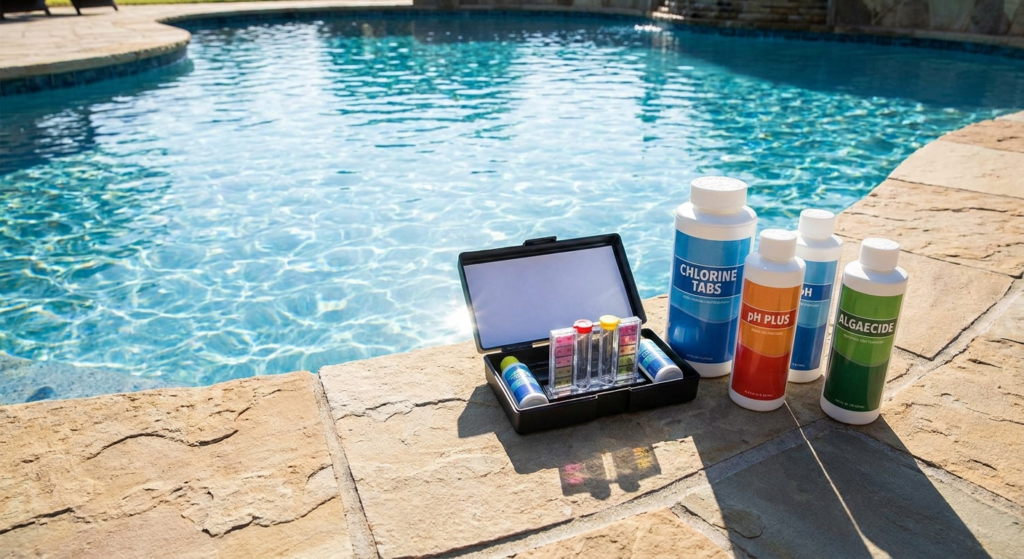

Maintaining balanced pool water chemistry is essential for swimmer safety, equipment longevity, and water clarity.
When the five key parameters — free chlorine, pH, total alkalinity, calcium hardness, and cyanuric acid — are kept within their ideal ranges, the water remains clean, comfortable, and non-damaging to surfaces and equipment.
This guide explains what each parameter does, how they interact, and the correct sequence for adjustments.
Pool water chemistry is an interconnected system where changing one parameter affects several others.
Chlorine effectiveness depends on pH. pH stability depends on total alkalinity. Calcium hardness affects surface longevity.
Cyanuric acid protects chlorine from UV degradation but reduces its killing power.
Understanding these relationships allows pool owners to move from reactive dosing to proactive water management.
Why Water Chemistry Matters
Improperly balanced water creates two categories of problems: damage to the pool and discomfort or health risk for swimmers.
Water that is too acidic corrodes metal equipment, etches plaster surfaces, and irritates eyes and skin.
Water that is too alkaline reduces chlorine effectiveness, promotes scale formation, and often turns the water cloudy.
The goal is to maintain water that is neither corrosive nor scale-forming — chemistry that is balanced, sanitized, and comfortable.
The Five Core Parameters
Five parameters define whether pool water is balanced, safe, and non-damaging. Each plays a specific role, and all must be kept within their recommended ranges.
Free Chlorine (FC)
Free chlorine is the primary sanitizer, maintained between 2 and 4 ppm for residential pools using stabilized chlorine. It kills bacteria, viruses, and algae.
Free chlorine is the portion of total chlorine available to kill pathogens.
Combined chlorine (CC) forms when chlorine reacts with nitrogen compounds from sweat, urine, and organic debris, creating chloramines.
These cause the characteristic pool smell and eye irritation wrongly attributed to excess chlorine.
If combined chlorine exceeds 0.5 ppm, breakpoint chlorination is needed.
pH
pH directly controls how much free chlorine is in its active killing form versus its weaker ionic form.
At pH 7.2, roughly 63 percent of free chlorine is active. At pH 7.8, only about 33 percent is active.
This means a pool at pH 7.8 with 3 ppm free chlorine has less sanitizing power than a pool at pH 7.2 with 2 ppm.
The ideal range is 7.4 to 7.6, balancing sanitizer effectiveness with bather comfort and equipment protection.
Total Alkalinity (TA)
Total alkalinity acts as a buffer system that resists pH changes. Low alkalinity causes pH to bounce erratically with every chemical addition or bather load. High alkalinity makes pH stubbornly resistant to adjustment. The target range is 80 to 120 ppm for most residential pools.
Calcium Hardness (CH)
Calcium hardness prevents water from becoming aggressive toward plaster and metal surfaces. Low levels cause water to seek minerals from pool surfaces, leading to etching and pitting. High levels cause scaling. The target range is 200 to 400 ppm.
Cyanuric Acid (CYA)
Cyanuric acid, or stabilizer, protects chlorine from UV degradation.
Without CYA, direct sunlight destroys 75 to 90 percent of free chlorine within two hours.
With 30 ppm CYA, chlorine loss drops to roughly 10 to 15 percent per day.
The target range is 30 to 50 ppm for manually dosed pools and 60 to 80 ppm for saltwater generator pools.
The Correct Order of Chemical Adjustment
Always balance pool chemicals in a specific sequence. Adjusting out of order wastes chemicals and time. Total alkalinity is first because it controls pH stability.
Once TA is set, pH can be adjusted without bouncing back. Calcium hardness comes third, as it changes slowly. Cyanuric acid is fourth, added based on chlorine needs.
Chlorine is last, working at maximum efficiency once everything else is balanced.
- Total Alkalinity (80–120 ppm) — Use sodium bicarbonate to raise, muriatic acid to lower.
- pH (7.4–7.6) — Use soda ash to raise, muriatic acid to lower.
- Calcium Hardness (200–400 ppm) — Use calcium chloride to raise, partial drain and refill to lower.
- Cyanuric Acid (30–50 ppm) — Use granular stabilizer to raise, partial drain and refill to lower.
- Free Chlorine (2–4 ppm or 7.5% of CYA) — Use liquid chlorine, cal-hypo, or trichlor tablets.
Understanding the CYA-Chlorine Relationship
The relationship between cyanuric acid and free chlorine is one of the most overlooked aspects of pool chemistry.
The minimum effective free chlorine level increases as CYA rises.
Industry research indicates that the ratio of FC to CYA should be maintained at approximately 7.5 percent.
A pool with 30 ppm CYA needs a minimum of about 2 to 3 ppm FC.
A pool with 80 ppm CYA needs 6 ppm FC or more to achieve the same sanitizing effect.
CYA accumulates over time because it does not degrade, evaporate, or get consumed by the sanitization process. Every trichlor tablet adds CYA to the water.
By mid-season, CYA levels of 80 to 150 ppm are common in trichlor-only pools, requiring proportionally higher chlorine levels that become impractical to maintain.
The only practical way to reduce CYA is dilution through partial drain and refill.
Testing CYA monthly and planning a partial drain when levels exceed 70 to 80 ppm is recommended.
A pool with 100+ ppm CYA and only 2 to 3 ppm FC may test fine on a standard test kit but has dangerously low sanitizing capability.
Algae blooms in pools with seemingly adequate chlorine are almost always caused by excessive CYA reducing chlorine effectiveness.
Because pool water changes with heat, rain, swimmer load, and chemical use, a comprehensive pool chemistry guide can help explain why regular testing and small adjustments matter.
Breakpoint Chlorination and Shock Treatments
Breakpoint chlorination destroys all combined chlorine in the water.
The breakpoint occurs at a free chlorine dose equal to approximately 10 times the combined chlorine reading.
If combined chlorine is 1.0 ppm, raise free chlorine to roughly 10 ppm above the current level.
Adding less than this amount actually increases combined chlorine rather than destroying it.
The process is straightforward: test for free and total chlorine, calculate combined chlorine, multiply by 10 to determine the target FC increase, add unstabilized chlorine, run the pump continuously, and retest after 12 to 24 hours.
Shock the pool when combined chlorine exceeds 0.5 ppm, after heavy use, after rain storms, weekly during peak season, and when opening or closing the pool.
Maintaining Balance Year-Round
Regular testing is the foundation of good pool chemistry.
During swim season, test free chlorine and pH two to three times per week. Test total alkalinity and calcium hardness monthly.
Always test before adding chemicals, and never add more than the recommended dose at one time.
By understanding how each parameter interacts and following the correct adjustment sequence, pool owners can maintain clear, safe water with less effort and expense over time. Proactive water management beats reactive problem-solving every time.